Short production runs give manufacturers room to test demand, refine designs, and build specialized parts without ordering thousands of pieces. Local CNC machining near me facilities can make that process easier by combining flexible scheduling, accurate equipment, and repeatable inspection with smaller order quantities. That balance works well for robotics, automation, replacement components, pilot programs, and products that are still moving toward full production.
Cost-Effective Machining Without High-Volume Production Commitments
Large manufacturing programs often justify expensive dedicated tooling because the cost spreads across thousands of pieces. Low-volume work follows a different cost structure, so capable machining companies near me may use reusable fixtures, standard cutters, soft jaws, and programmable equipment instead. Flexible setups allow manufacturers to order the quantity they currently need without paying for production systems designed around much larger volumes. Careful process planning can also reduce material waste and unnecessary setup hours, helping smaller batches remain practical without lowering dimensional requirements.
Flexible Batch Sizes for Changing Production Requirements
Demand does not always rise in a straight line. Product testing, seasonal orders, replacement needs, customer feedback, or changes in an automation project can cause quantities to shift between one purchase order and the next. Responsive CNC services near me can handle those changes more easily when programs, fixtures, and inspection plans already exist.
Smaller batch options also reduce inventory exposure. Purchasing hundreds of parts before a design is fully proven can leave a company holding components that no longer match the latest revision. Staged ordering lets engineering and purchasing teams increase quantities as confidence grows, while a custom machine shop can preserve the approved setup for later runs.
Multi-Axis CNC Access for Complex Low-Volume Components
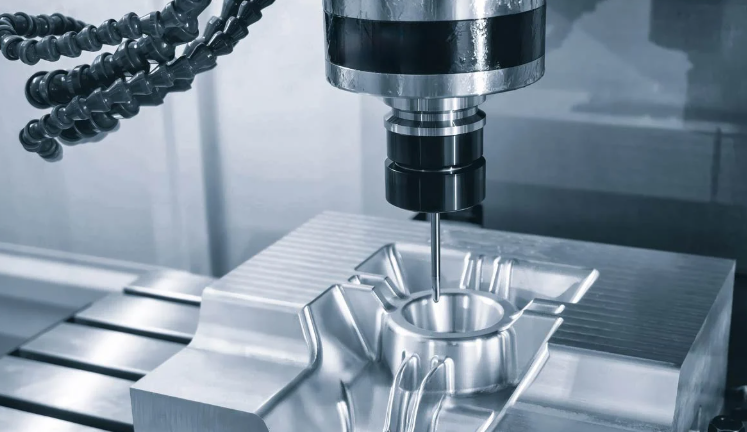
Complex geometry does not become simpler just because the order is small. Five-axis and other multi-axis equipment can reach angled faces, curved profiles, deep pockets, and features on several sides without requiring a long series of separate setups. Reduced reclamping saves setup time and helps protect feature-to-feature alignment on robotic brackets, housings, fixtures, and specialized machine parts. Advanced machining services near me can therefore make intricate low-volume components practical even when traditional tooling would require too much manual repositioning.
Tight Tolerance Control Across Short Production Runs
Small quantities still need parts that fit and function correctly. Bearings, dowel pins, seals, shafts, and mating surfaces can fail to assemble properly if dimensions move outside the specified tolerance, regardless of whether the batch contains ten pieces or ten thousand. Reliable precision machining companies treat short runs with the same attention to offsets, tool wear, temperature, and workholding used on larger programs.
Consistent CNC programming helps every part begin from the same cutting strategy. Scheduled measurements then show whether dimensions are shifting as tools wear or material conditions change. Buyers comparing CNC machining near me should ask how first-article approval and in-process checks are handled, since those controls can prevent a small run from becoming an expensive group of rejected components.
Reduced Need for Dedicated High-Volume Tooling
Dedicated fixtures, transfer systems, dies, and automated loading equipment can make sense when enormous quantities are involved, but those investments may be difficult to justify for limited production. Programmable machines let shops produce many low-volume jobs with adaptable tooling instead. Modular workholding can be adjusted for new revisions, while reusable cutters handle multiple features without creating a special tool for each operation. Practical CNC services near me can therefore keep setup costs closer to the actual needs of the project.
CMM Inspection for Consistent Part Verification
Coordinate measuring machines can verify complex dimensions that calipers and micrometers cannot fully capture. A CMM may check hole position, profile, flatness, perpendicularity, concentricity, and relationships between defined datums, which is especially useful on multi-sided parts with close geometric tolerances. Digital inspection routines can also be saved with the production records.
Repeatable measurement becomes valuable as low-volume orders return over time. An approved run produced months earlier provides a useful reference for later batches, but only if the inspection method remains consistent. Organized machining companies near me can use stored CMM programs and documented acceptance criteria to compare new parts against the same standards instead of recreating the process from memory.
Easier Transition From Prototype to Low-Volume Production
Prototype machining often reveals details that are hard to judge from a CAD model alone. Physical testing may show that a wall needs more thickness, a fastener needs better access, or a tolerance can be relaxed without affecting performance. Moving from that prototype into a small production batch allows engineers to test the improved design across several assemblies before committing to higher quantities.
Amtec Solutions Group can help manufacturers move low-volume industrial and robotic components from tested designs into production with flexible batch sizes, precise machining, and dependable inspection, without requiring a large-volume commitment.