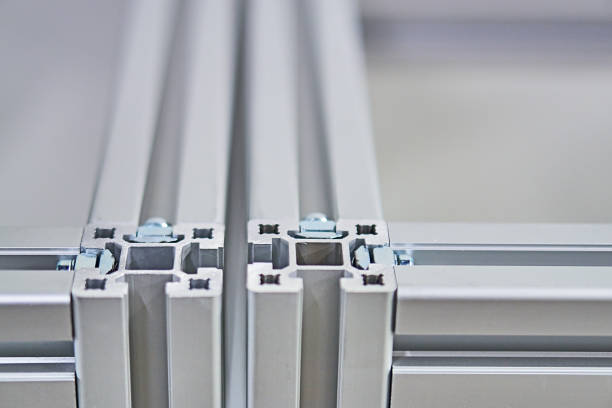
Bracket selection affects how securely an aluminum frame holds its shape, carries loads, and supports guards or accessories. Different angles and plates solve different connection problems, from basic right-angle joints to adjustable guard mounts and reinforced intersections. Understanding what each part does helps builders get more from MiniTec Aluminum Framing without overcomplicating the structure.
Angle 45 VA Stainless Steel
Built for strong right-angle connections, the Angle 45 VA Stainless Steel bracket gives a frame a durable mounting point where two profiles meet. Stainless construction makes it useful in areas where moisture, cleaning, or surface wear may be a concern. Because the bracket mounts externally, technicians can inspect its fasteners without taking the surrounding frame apart. Placed along an extruded aluminum T slot, it can reinforce corners on guards, equipment supports, workstations, and other modular structures. For applications that may need future changes, the bolted connection also allows the joint to be loosened and repositioned instead of cut apart.
Guard Unit Fixing Angle GD-K
Designed specifically around guard construction, the Guard Unit Fixing Angle GD-K helps attach protective sections to the main frame. Guard panels need secure mounting because repeated door movement, machine vibration, or light contact can slowly work poorly supported sections out of alignment. Its compact shape keeps the connection close to the T slot extrusion rather than adding a bulky bracket around the guard opening. Installers can use the existing profile channels for attachment, which reduces extra drilling during assembly. That straightforward connection style works well with MiniTec extruded aluminum framing used for machine barriers, perimeter guards, and enclosed production areas.
Angle 45×90 GD with hardware
Larger joints sometimes need a bracket with more surface area than a compact corner angle provides. Supplied with matching hardware, the Angle 45×90 GD helps connect profiles while spreading the fastening force across a wider section of the frame. This wider footprint can improve rigidity around taller guards, heavier panels, or places where a joint sees repeated movement. Compared with improvised fasteners, matched hardware also helps the bracket sit correctly against the T slot aluminum extrusion and keeps installation more predictable. Applications such as equipment enclosures, conveyor supports, and operator stations can benefit from the added contact area without moving to welded steel connections.
Guard Unit Adjustable
Adjustable guard hardware gives installers room to correct panel position after the main structure is already standing. Rather than forcing a guard into a fixed location, the bracket can help fine-tune spacing around doors, access points, or uneven panel edges. Once everything lines up, the fasteners lock the assembly in place against the aluminum framing material. Teams building large enclosures may find this especially helpful because small dimensional differences can add up across several profiles. Such adjustment also makes later panel replacement easier when a new guard section does not match the original fit perfectly.
Angle Sheet VA
Formed sheet angles provide a simple way to reinforce corners while keeping the connection fairly low profile. Hardware included with the Angle Sheet VA removes the need to match separate nuts and bolts before assembly, which can save time on repeat builds. A sheet-style bracket can work well where the joint needs broad contact but does not require a thick cast fitting. Flat surfaces also make this type of angle useful near panels, doors, or equipment where clearance is limited. Within an aluminum framing kit, these brackets give builders another way to strengthen corners without adding unnecessary mass to every connection.
T Sheet VA
Shaped like a T, this plate supports three-way intersections where one profile meets another along its length. Three-way joints appear often in machine frames, shelving, workstation supports, and guards that need a centered cross member. Using a plate across the connection can help keep the intersecting rails aligned while distributing force between several fasteners. Load transfer matters here because a center rail may support shelves, panels, controls, or other mounted equipment. Builders working with MiniTec Aluminum Framing can use this style of plate to create cleaner intersections without machining custom tabs or welding separate supports.
Connecting Plate 90×90 (with hardware)
Square connecting plates are useful where a larger joint area needs reinforcement or where two profiles meet across a broad face. Multiple mounting holes let the plate spread force beyond a single fastener, which can improve stability around workstations, conveyor frames, guards, and other structures that experience repeated use. Bolted installation keeps the connection compatible with the modular nature of an extruded aluminum T slot system and makes later removal possible. Careful placement helps the plate reinforce the frame without blocking nearby accessories, covers, or panel mounts. MiniTec Solutions offers a range of angle brackets, connecting plates, and compatible fastening hardware. Manufacturers can use these components to build stronger corners, reinforce profile intersections, mount guard sections, and create adjustable connections while keeping assembly clean and easy to modify. With several bracket and plate styles available, MiniTec Solutions can help match the connection hardware to the frame’s layout, load, and intended application.